
What is Barratry in Texas?
DO YOU KNOW WHAT "BARRATRY" IS?
If you have been in a car accident in Texas, you may have experienced something unsettling: an unexpected phone call from someone claiming to be a lawyer or a legal representative, or an out-of-the-blue text message or a stranger showing up at your door, urging you to hire a specific attorney or provide “injury assistance”. You may have wondered whether that was normal — or even legal. The answer, in most cases, is NO. What you likely experienced is a practice known as barratry, and in Texas, it is a crime.
Barratry is one of the most predatory and deceptive practices in the legal industry. It preys on accident victims at some of their most vulnerable moments — right after an accident, when they are injured, scared, and confused about what to do next. Understanding what barratry is, how it works, and what the law says about it can protect you from falling victim to unethical law firms that care more about your case value than your recovery.
THE DEFINITION OF BARRATRY
Barratry is the illegal solicitation of legal business. In Texas law, barratry has a specific meaning codified underTexas Penal Code Section 38.12 — "Barratry and Solicitation of Professional Employment."
Under Texas law, a person commits barratry when, with the intent to obtain an economic benefit, they engage in conduct such as:
- Soliciting legal employment in person, by telephone, through social media direct messages, or through other electronic communications
- Paying, giving, or offering to give money or something of value to a prospective client in exchange for hiring them
- Paying or offering to pay another person to solicit clients on their behalf — this includes paying runners, investigators, or referral sources
- Knowingly filing a lawsuit or claim that the person has not been authorized to pursue
- Using false, misleading, or deceptive communications to solicit employment
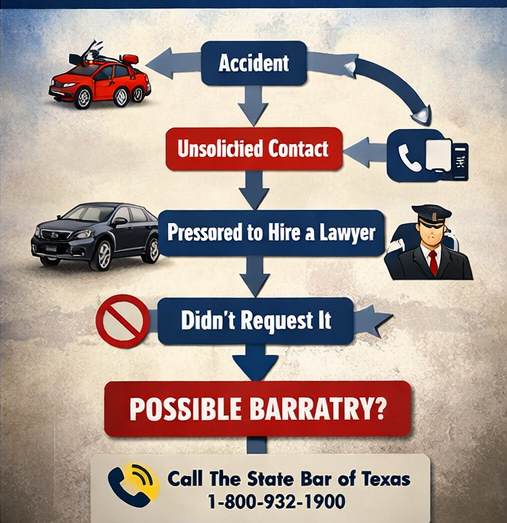
Importantly, barratry laws do not just apply to attorneys. Non-lawyers who solicit clients on behalf of law firms — often called "runners" or "cappers" — can also be criminally charged under Section 38.12.
HOW DID BARRATRY BECOME SUCH A PROBLEM IN TEXAS?
Texas has long been fertile ground for personal injury litigation, and the financial stakes in car accident cases can be enormous. A serious crash involving significant injuries, commercial vehicles, or multiple parties can generate legal fees in the hundreds of thousands of dollars. That potential for profit has, over the years, attracted a subset of law firms and individuals willing to bend or break the rules to capture clients before those clients have a chance to make an informed, independent decision about who to hire.
High-volume law firms — sometimes called "settlement mills" — often rely on aggressive client acquisitions to keep their case numbers up. Rather than building a reputation on results and relationships, these firms invest heavily in being first to contact accident victims. They use paid runners who monitor police scanners and accident reports, hospital insiders who tip them off about new patients, and now, increasingly, social media scraping and digital targeting to reach injured people within hours of a crash.
The result is a race to the victim — and the victim almost always loses in that race, regardless of which firm "wins" it.
REAL-WORLD EXAMPLES: WHAT BARRATRY LOOKS LIKE AFTER A CAR WRECK
Barratry does not always look like what you might expect. It rarely involves a lawyer in a suit handing you a business card at the scene. More often, it is subtle, disguised, and designed to make you feel like you are receiving help rather than being solicited. Here are some realistic scenarios of how barratry typically unfolds after a car accident in Texas:
Scenario 1: The Unexpected Visitor
Maria is rear-ended on I-30 near Fort Worth. The police respond, a report is written, and she is taken to the Harris Methodist Hospital emergency room with neck and back pain. The next morning, a man shows up at her house. The man introduces himself as a "legal consultant" and says he heard about her accident. He expresses sympathy, tells her how insurance companies take advantage of unrepresented people, and tells her about a law firm he "works with." He tells her she should sign a representation agreement now before the insurance company contacts her and tries to get a recorded statement.
This man is a runner — a paid solicitor working on behalf of a law firm. He likely obtained Maria's name and address from the accident report, which in Texas is a public record. His uninvited visit to her house is barratry. The law firm he represents is just as culpable as he is.
Scenario 2: The Phone call or Text Message
Nathan is involved in a rear-end car accident on Airport Freeway in Bedford, Texas. That same evening, he receives an unsolicited call from a "legal intake specialist" and a text from an unknown number — both knowing about his accident within hours. The scenario explains how his information became a commodity through a runner network tied to accident reports, towing companies, or medical facilities. It closes by making clear that both the call and the text are explicitly illegal under Section 38.12 — including the 2025 amendment now expressly covering electronic communications — regardless of how helpful the caller sounds.

Scenario 3: The Hospital Visit
David is hospitalized after a serious collision with an 18-wheeler on Highway 199 in Azle, Texas. While he is still in the hospital, recovering from surgery, a person visits his room claiming to be a "patient advocate" or a representative from a medical billing assistance program. They are friendly and helpful, offer to assist with paperwork, and at some point, slide a legal representation agreement in front of David to sign.
This scenario — unfortunately not uncommon in Texas — involves a runner who may have been tipped off by a hospital employee, a medical transport worker, or someone else with access to patient information. The conduct is illegal, and any contract David signs in this situation may be voidable under Texas law.
WHAT DOES TEXAS LAW SAY ABOUT BARRATRY PENALTIES?
Texas takes barratry seriously — at least on paper. The penalties under the law are significant:
- A first barratry conviction is a Class A misdemeanor, punishable by up to one year in county jail and a fine of up to $4,000.
- Subsequent convictions are third-degree felonies, carrying a punishment range of two to ten years in prison and a fine of up to $10,000.
- A convicted attorney faces discipline by the State Bar of Texas, up to and including disbarment.
Beyond the criminal penalties, Texas law also provides civil remedies for victims of barratry. Under Texas Government Code Section 82.0651, a person who was solicited through barratrous conduct — even if they did not sign a contract — may bring a civil lawsuit and recover a statutory penalty of $10,000 for each illegal solicitation, plus actual damages and attorney's fees.
If a client did sign a contract with a law firm because of barratrous conduct, that contract is voidable. The client can void it, get back the fees and expenses they paid, and recover a minimum of $50,000 in statutory damages under Texas Government Code Section 82.0651. This is an important protection — you are not locked into an attorney you were illegally solicited to hire.
THE ROLE OF "RUNNERS" IN BARRATRY SCHEMES
One of the most common mechanisms by which barratry operates is through third-party solicitors — people who are not attorneys, but who are paid by law firms to find and sign up clients. In Texas legal circles, these individuals are commonly referred to as "runners" or "cappers."
Under Texas Penal Code Section 38.12, paying any individual to solicit clients is a crime. The attorney or firm that pays for the referral is guilty of barratry. The runner who solicits the client is guilty of barratry. It does not matter how the payment is characterized — whether as a "consultation fee," a "marketing agreement," or something else entirely. If money is changing hands in exchange for client referrals, the law is clear: that is barratry.
WHY BARRATRY HURTS ACCIDENT VICTIMS
Beyond the legal violations, barratry causes real harm to the very people it purports to help. When a law firm acquires clients through illegal solicitation, the relationship starts with a foundation of manipulation. The client did not choose the attorney based on reputation, referrals from people they trust, or their own research. They were targeted, often while still dazed and disoriented from the accident.
High-volume firms that rely on runners to fill their caseloads are, almost by definition, handling too many cases to give any individual client meaningful attention. These firms operate like assembly lines — intake, medical treatment referrals, demand letters, and settlements — often without ever preparing a case for trial or truly evaluating the full value of a client's injuries. The result is that clients receive quick, undervalued settlements that benefit the firm's bottom line more than the client's actual recovery.
Legitimate attorneys who have earned their clients through reputation, word of mouth, and honest marketing invest deeply in each case. They know their clients as people, not case numbers. They evaluate cases thoroughly, prepare for trial from day one, and make realistic, evidence-based demands that reflect what the client has suffered.
WHAT ARE LAWYERS ACTUALLY ALLOWED TO DO TO ADVERTISE?
Texas law does allow attorneys to advertise and to reach out to potential clients under specific circumstances. It is important to understand the line between permissible legal marketing and illegal barratry.
What attorneys cannot do is directly contact you in person, by phone, or through electronic messages — including social media direct messages and text messages — to solicit your business after an accident. They cannot send runners to do it on their behalf. And they cannot use false or misleading information to induce you to hire them.
The key distinction is this: if a law firm reaches you through a medium that you chose to receive — like turning on the television, driving past a billboard, or visiting a website — that is advertising. If a law firm reaches you because someone targeted you personally after your specific accident and contacted you unsolicited, that is likely barratry.
WHAT SHOULD YOU DO IF YOU ARE THE VICTIM OF BARRATRY?
If you believe you were the target of illegal solicitation after a car accident in Texas, there are several steps you can take to protect yourself:
- Do not sign anything on the spot. Any legitimate attorney will give you time to think, ask questions, and consult with others before signing a contract. Pressure to sign immediately is a red flag.
- Ask how they found you. A legitimate attorney cannot legally contact you in person or by phone based on knowledge of your specific accident. If you ask how they got your information and the answer is vague or evasive, trust your instincts.
- Report the conduct to the State Bar of Texas. The State Bar has a grievance system for reporting attorney misconduct, including barratry. You can file a complaint at texasbar.com.
- If you already signed a contract, you may be able to void it. Under Texas Government Code Section 82.0651, a contract procured through barratry is voidable, and you may be entitled to significant statutory damages. Consult an independent attorney about your options.
- Consider filing a civil lawsuit. If you were solicited through barratrous conduct, you may be entitled to recover $10,000 per illegal solicitation, plus actual damages and attorney's fees.
HOW TO FIND AN ETHICAL PERSONAL INJURY ATTORNEY AFTER A CAR ACCIDENT
Choosing the right attorney after a car accident is one of the most important decisions you will make. The attorney you hire will determine how thoroughly your case is investigated, how aggressively your rights are protected, and ultimately how much compensation you receive for your injuries, medical bills, lost wages, and pain and suffering.
Here are some guidelines for finding an attorney you can trust:
- Ask for referrals from people you trust — family, friends, or colleagues who have had positive experiences with a personal injury attorney. Word-of-mouth referrals from people whose judgment you respect are the gold standard.
- Look for attorneys who limit their caseloads and provide personal attention. High-volume firms that handle hundreds or thousands of cases per year are unlikely to give your case the individual focus it deserves. Look for a firm where you will actually speak to and work directly with your attorney.
- Research the attorney's reputation and experience. How long have they been practicing personal injury law in Texas? Do they have trial experience, or do they only settle cases? Do they have a track record of results?
- Meet with the attorney personally before signing anything. Any reputable personal injury attorney offers a free initial consultation. Use that meeting to ask questions, assess whether they listen to you, and get a feel for whether you trust them.
- Be cautious of any attorney who pressures you to sign quickly. An attorney who is confident in the quality of their representation does not need to pressure you. They will give you time to make the right decision.
THE BOTTOM LINE
Barratry is not a technicality or a minor ethical gray area. It is a crime in Texas, and it is a form of predatory conduct that targets people when they are most vulnerable. The law firms and individuals who engage in barratry are not interested in justice for accident victims — they are interested in capturing clients and processing cases for profit.
If you or a loved one has been involved in a personal injury accident in the Fort Worth or Dallas area, you deserve an attorney who found you the right way — through reputation, through the recommendation of someone who knows their work, or through your own deliberate search for the best possible representation.
You deserve an attorney who will treat your case with the attention and seriousness it warrants, prepare it for trial from the very beginning, and fight for the full compensation you are owed.
Knowing what barratry is — and knowing how to recognize it — is your first line of defense against those who would exploit your misfortune for their own gain.